Business requirements document (BRD) template and example
A business requirements document records what the business needs from a project, and why, before anyone designs or builds. This page gives you the sections to include, a short filled-in example, and a plain-text template you can copy. Use it for a new system, a process change or a vendor brief.
What goes in a BRD
- Purpose and background. The problem in two or three sentences, who has it, and what happens today. Say what triggered the project.
- Goals and success measures. What should be different afterwards, and how you will tell. Prefer measures you can check: cycle time, error count, cases per person.
- Scope. What is in, what is out, and where the process starts and ends. The “out” list prevents most arguments later.
- Stakeholders and roles. Who does the work, who decides, who is affected, who owns each system involved.
- Current process. A short description or a swimlane diagram of how the work runs today, including workarounds.
- Requirements. Numbered, one statement each, with a priority and the source (person, document or observed case). Separate what the business needs from how a system might do it.
- Data and documents. What information the process uses, where it lives, and what must be kept or reported.
- Assumptions, constraints and dependencies. Things you believe but have not confirmed, fixed limits such as law, budget or deadlines, and work that has to happen first.
- Risks and open questions. Each with an owner and a date. Unknowns left visible are far cheaper than unknowns discovered in testing.
- Approval. Names, roles and dates of the people who accept the document, and how changes are agreed afterwards.
Example: purchase request approval
A shortened BRD for a small company that approves purchases by email. It is an illustration, not a real case.
1. Purpose
Purchase requests reach managers by email and are approved in the order they are noticed. Requesters cannot see the status of a request and finance re-enters each approved request by hand. The company wants one place to submit, approve and record purchases.
2. Goals
- A requester can see the status of every request without asking.
- Approved requests reach finance without re-typing.
- Measure: median time from submission to decision, and the number of requests re-keyed, both counted for one month before and one month after the change.
3. Scope
In: requests for goods and services under the company limit, from submission to the purchase order number. Out: invoices and payment, contracts, and purchases made by card.
6. Requirements
Each requirement has an ID, one statement, a priority and a source.
- R-01 (Must, source: interview with requester): A requester can submit a request with item, supplier, amount and cost centre.
- R-02 (Must, source: interview with team lead): The system routes the request to the approver for that cost centre.
- R-03 (Must, source: policy doc v3): Requests above the manager limit go to a second approver before finance sees them.
- R-04 (Should, source: interview with requester): The requester is told when a request is approved or rejected, with the reason if rejected.
- R-05 (Should, source: interview with finance): Finance can export approved requests with their purchase order numbers.
- R-06 (Could, source: open question): An approver can delegate while on leave.
8. Assumptions and open questions
- Assumption: the cost centre list is kept by finance and changes rarely. Not yet confirmed.
- Open: what happens to a request when its approver has left the company? Owner: HR contact. Due: before design starts.
Copy-paste template
Copy the lines below into your document and fill them in.
- BUSINESS REQUIREMENTS DOCUMENT
- Project / process:
- Version, date, author:
- 1. Purpose and background
- 2. Goals and success measures (with how each is measured)
- 3. Scope: in / out / starts at / ends at
- 4. Stakeholders and roles
- 5. Current process (diagram or short description)
- 6. Requirements
- ID | Requirement (one statement) | Priority | Source
- 7. Data and documents
- 8. Assumptions, constraints, dependencies
- 9. Risks and open questions (owner, date)
- 10. Approval (name, role, date)
Mistakes to avoid
- Writing the solution as a requirement. “Add a dropdown” is a design choice. “The requester picks a cost centre from the valid list” is the need.
- Vague words. “Fast”, “user-friendly” and “as needed” cannot be tested. State a number or a condition.
- Requirements with no source. If nobody said it and no document shows it, label it an assumption and ask.
- Interviewing managers only. They describe the process as designed. The people doing the work describe how it runs, including the workarounds the BRD must cover.
- No out-of-scope list. Without one, every conversation reopens the boundary.
- Hiding the gaps. Open questions belong in the document, with an owner, not in someone's head.
Getting the content
A BRD is only as good as what you learned before writing it. Most of the content comes from talking to the people who do the work: see our requirements gathering interview kit for questions and a notes template. Then draw the current process – a swimlane diagram with one lane per role works well – and mark on each step who told you, so the “current process” and “source” columns above can be checked rather than remembered.
If the BRD feeds a build with AI coding agents, see what spec-driven development is.
We tested it (2026-11-14)
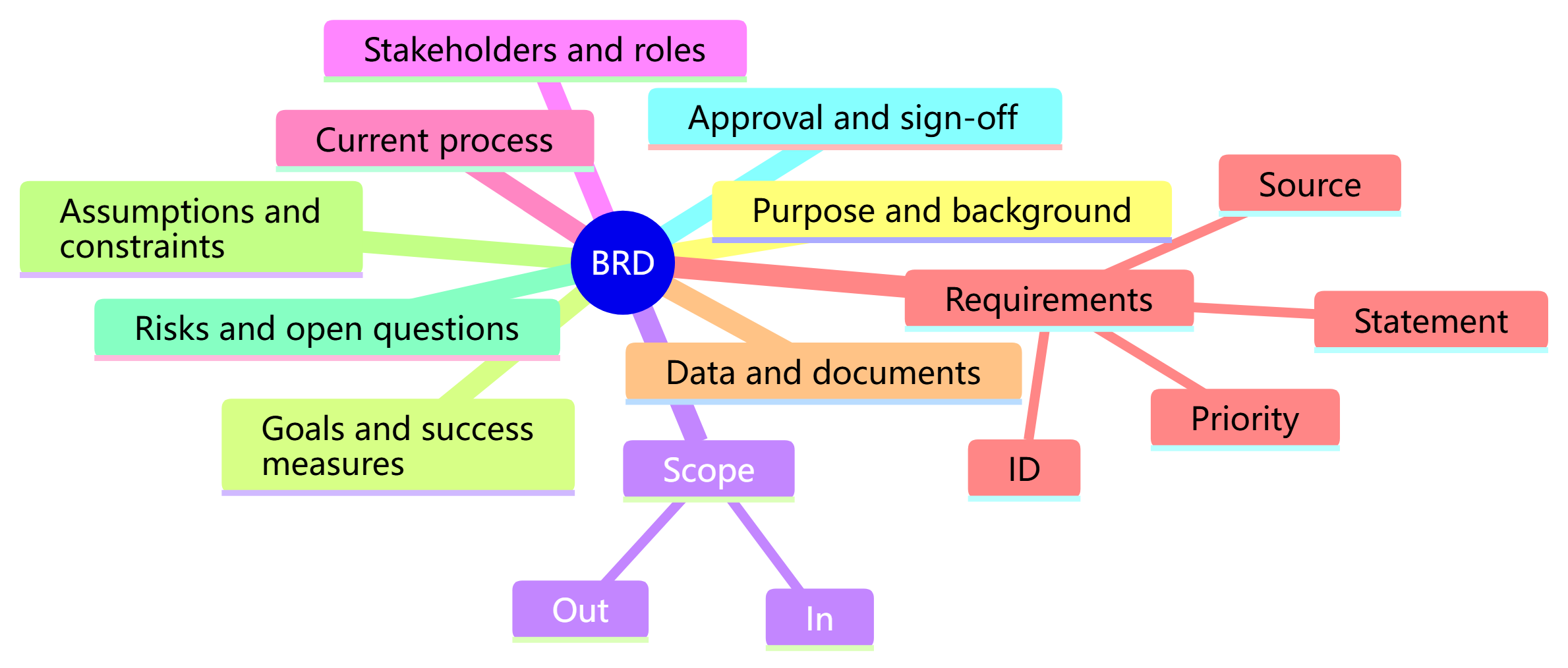
On 2026-11-14 we opened this page on a desktop browser, kept the BRD mind map preset and edited the last branch from Approval to Approval and sign-off. The preview redrew live, and Download PNG saved business-requirements-document-template.png (2379 × 1014 px, 234 KB) with all ten BRD branches and the Scope / Requirements sub-branches intact.
Our read: the mind map gives a fast overview of all ten BRD sections on one slide. One limit we hit during testing: in Mermaid mindmap syntax, parentheses like `Approval (name, role, date)` are parsed as a rounded-node delimiter rather than plain label text, so keep branch labels free of parentheses or wrap them in quotes.
On a phone
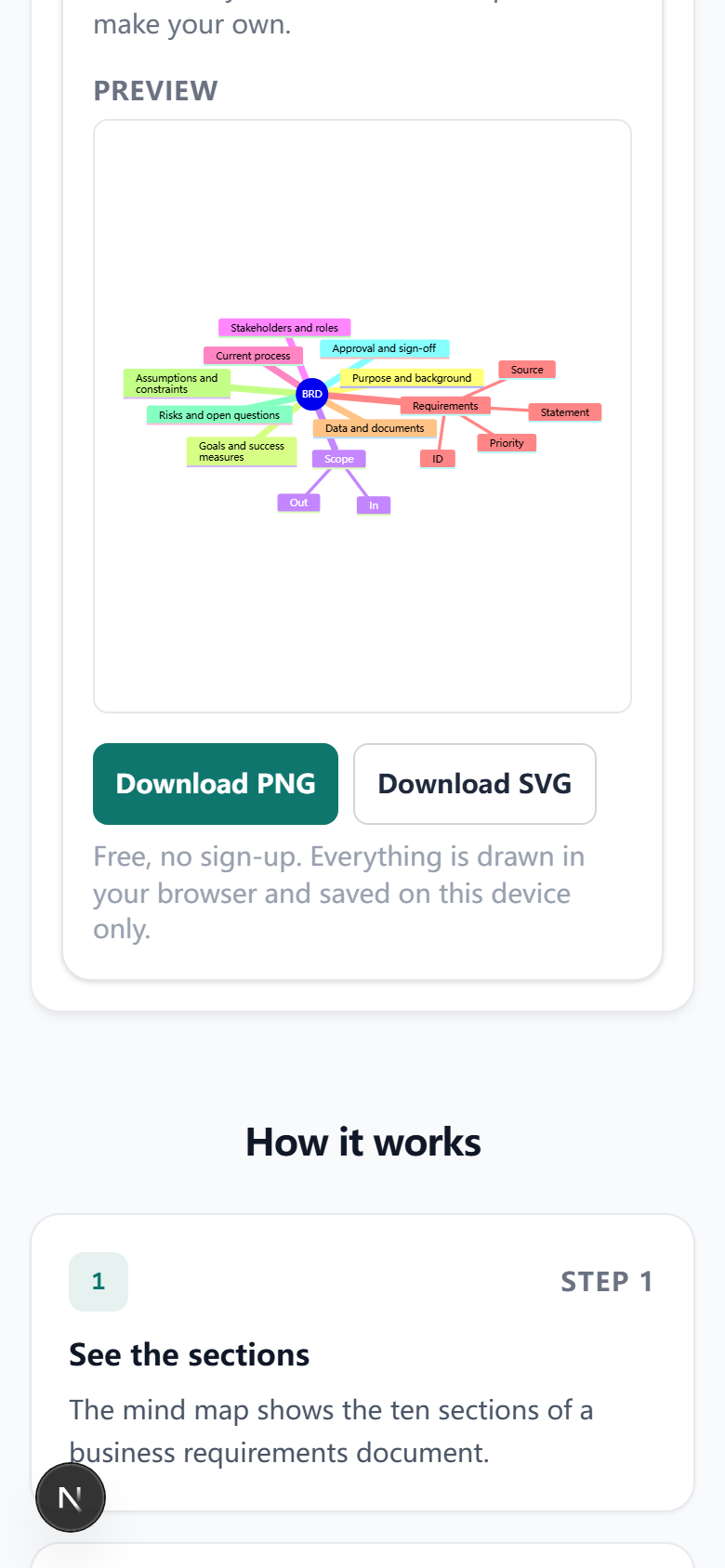
The same day at 390 px phone width: the page renders with no horizontal overflow (scrollWidth 390 px), and the mind map preview and Download PNG / Download SVG buttons sit cleanly above the step cards. Because ten branches radiate around the central BRD node, small sub-labels are easier to inspect after downloading the PNG or viewing in landscape.
Frequently asked questions
- What is a business requirements document?
- A business requirements document (BRD) states what a business needs from a project or system and why, without saying how it will be built. It covers the problem, the goals, the scope, who is affected, the requirements themselves and how success will be judged. Developers, testers and approvers all work from the same agreed text.
- What is the difference between a BRD and a functional specification?
- The BRD describes the business need and the outcomes expected, in the business's language. A functional specification describes what the system will do to meet them: screens, rules, data and interfaces. Write the BRD first; the functional specification answers it requirement by requirement.
- How long should a business requirements document be?
- As long as it takes to remove doubt, no longer. A small process change can fit on two or three pages. A larger project needs more, but a long document is not a good one: if nobody can find the requirement they need, split it or cut it.
- Who writes and who signs off a BRD?
- Usually a business analyst or product owner writes it with input from the people who do the work. Sign-off belongs to the business owner of the process and to whoever funds or delivers the change. Record names and dates so later changes can be traced.
- How do I get the content for a BRD?
- From the people who do the work today. Interview them one process at a time, collect real forms and examples, and keep a note of where each statement came from. Anything you cannot trace to a person or a document is an assumption and should be labelled as one.
Last updated: 2026-11-14